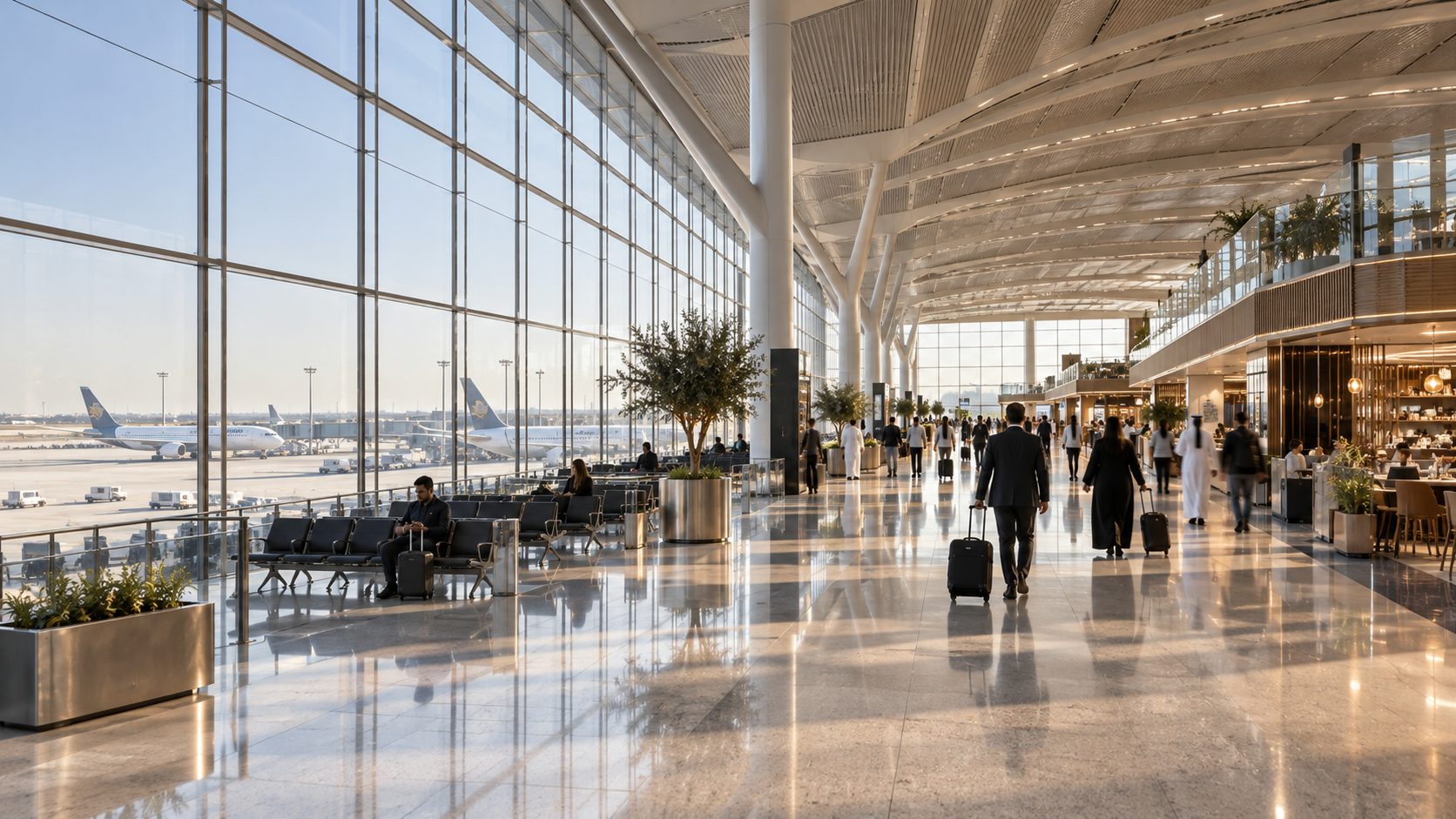
Non-aeronautical revenue is the money an airport earns from everything other than airline and passenger charges: shops, food and beverage, car parks, advertising, property and rental cars. For many airports it is the revenue line management can influence most directly, because aeronautical charges are usually regulated or negotiated with airlines.
Airports Council International (ACI) World's Airport Economics Report for 2023 covered more than 1,060 airports. It found that passenger numbers were 5.4% below 2019. Total airport revenue, at about $146 billion, was 11.4% below. Non-aeronautical revenue, at about $54 billion, was 17% below, and its share of total revenue fell from 40.2% in 2019 to 36.7%.
In short, travellers came back, but they spent less in the terminal. ACI's own summary put it plainly: passenger traffic recovery does not equal airport revenue recovery.
Where the money moved
ACI's breakdown shows the change was uneven. Comparing 2023 with 2019:
- Retail concessions fell from 27% of non-aeronautical revenue to 20%, with retail revenue down 18%.
- Duty-free revenue fell 34% and advertising revenue fell 23%.
- Car parking rose from 21% to 24% of non-aeronautical revenue, with revenue up 18%. ACI attributes most of this to North America.
- Food and beverage revenue grew 8%, and property and real estate revenue grew 7%.
ACI also notes a longer trend. Non-aeronautical revenue per passenger has been falling since 2016, at a compound annual rate of 2.3%. So the pandemic did not create the problem. It made an existing one larger.
Why it matters
Commercial income helps pay for the terminal. Where it falls short, the gap has to be filled by higher airline charges, more borrowing or delayed investment. ACI's own explanation for the decline points to changing consumer habits, economic uncertainty and competition from retail outside the airport.
Two of the categories that grew, food and beverage and property, are less exposed to that outside competition. A passenger can buy perfume online but has to eat before a flight. Land around an airport is in fixed supply.
Questions for airport leadership
- Is commercial space where passengers now wait? Gate changes, new security layouts and shifts in transfer traffic can move people away from shops without anyone deciding it.
- Do concession contracts reward sales or only occupancy? Fixed minimum guarantees protect income when sales fall, but can limit what the airport earns when they rise, and give operators little reason to refresh their offer.
- Is the retail mix built for how passengers buy today? The fall in duty-free and the rise in food and beverage suggest the answer has changed since many current contracts were signed.
- Is commercial income planned into capacity projects from the start? A new pier or terminal fixes where passengers walk and wait for decades.
ACI's figures are global averages. Individual airports, and regions, will differ widely. But the direction is clear enough to be worth testing against your own numbers.
Sources
- ACI World, "Maximizing non-aeronautical revenues: key to airport financial sustainability", 8 May 2025
- TRBusiness, "Airports struggle financially despite traffic rebound, says ACI World report" (coverage of the ACI World Airport Economics Report, 2023 data)
Related services and industries
Published by Midvale Consulting. Views are general in nature and are not advice for any specific situation.